Monday, November 25, 2013

JFK’s Berlin blunder - The Washington Post

No wonder he was so frustrated he sought solace with the interns.


http://www.washingtonpost.com/opinions/jfks-berlin-blunder/2011/08/12/gIQAGOcxBJ_story.html

Khrushchev treated Kennedy with brutal disdain. In excruciating pain from his ailing back and pumped full of perhaps disorienting drugs by his disreputable doctor (who would lose his medical license in 1975), Kennedy said that it was the "worst thing in my life. He savaged me." British Prime Minister Harold Macmillan said, "For the first time in his life, Kennedy met a man who was impervious to his charm." Kempe writes, "From that point forward Khrushchev would act more aggressively in the conviction that there would be little price to pay." Kempe says that when Robert Kennedy met with his brother back in Washington, "Tears were running down the president's cheeks."
As Khrushchev turned up the temperature on Berlin, Kennedy studied the modalities of conducting a nuclear war. On July 25, he gave a nationally televised address, referring 17 times to the U.S. commitment to West Berlin, although the entire city was under four-power (U.S., Soviet, British, French) rule.
On July 30, in a Sunday morning television interview, Sen. William Fulbright said: "I don't understand why the East Germans don't close their border because I think they have a right to close it." He was wrong regarding the four powers' rights, and five days later he apologized for giving "an unfortunate and erroneous impression." But Kennedy, who did not dispute Fulbright's mistake, evidently welcomed it.
After Aug. 13, an unsympathetic Kennedy, who never asserted the indisputable legal right of free movement of people throughout Berlin, told New York Times columnist James Reston that East Germans had had 15 years to flee to the West. Reston wrote that Kennedy "has talked like Churchill but acted like Chamberlain." 

RealClearPolicy - New Evidence Raises Doubts on Preschool for All


By way of background, I'm a developmental psychologist by training and spent the majority of my career designing and evaluating programs intended to enhance the cognitive development of young children. For instance, I directed a national Head Start Quality Research Center; created a program, Dialogic Reading (which is a widely used and effective intervention for enhancing the language development and book knowledge of young children from low-income families); and authored an assessment tool, the Get Ready to Read Screen, that has become a staple of early intervention program evaluation. My point is that I care about early childhood education and believe it is important -- as witnessed by how I spent my professional life for 30 years.
My career since 2001 has largely been about advancing evidence-based education, which is the endeavor of collecting and using the best possible evidence to support policy and practice in education. Since the president's state of the union address, I've been writing that the evidence is decidedly mixed on the impact of the type of preschool investments the president has called for and that we now see in the legislation introduced in Congress. It may seem in the pieces I've written that I'm wearing only my evidence-based education hat. But in fact if you're an advocate of strengthening early childhood programs, as I am, you also need to pay careful attention to the evidence -- all of it. Poor children deserve effective programs, not just programs that are well-intentioned.
http://www.realclearpolicy.com/blog/2013/11/20/new_evidence_raises_doubts_on_obamas_preschool_for_all_742.html
Should you be able to take people's money at gunpoint and give it to an industry without proof that the desired effect will take place?

Pseudo-Economics


http://cafehayek.com/2013/11/pseudo-economics.html

The world is full of people who do not understand economics.  That's not a sin or a crime.  The world is full also of lots of people who do not understand ancient Greek texts, matrix algebra, the consequences of the Peace of Westphalia, and how to make authentic cajun gumbo.  But as one of my brilliant colleagues, Bryan Caplan, points out with special clarity, most people who do not understand these latter things do not fancy that they understand these latter things.  The typical person ignorant of any mathematics beyond basic arithmetic doesn't go about in public pretending to be expert in matrix algebra.
Economics is different.  People who have no exposure to the economic way of thinking typically think that they understand sufficiently the logic of markets to comment critically upon real-world market processes.  As frustrating as this reality is – with its incessant outpouring of wrongheaded diagnoses and demands for this or that government intervention – it's a reality that ain't gonna go away.


A Little Knowledge is A Dangerous Thing at Steven Landsburg | The Big Questions: Tackling the Problems of Philosophy with Ideas from Mathematics, Economics, and Physics


I like this analysis, but the author doesn't mention that an assumption of the "complainant" is that carbon is pollution - it's anything but that!

Sent by a reader:


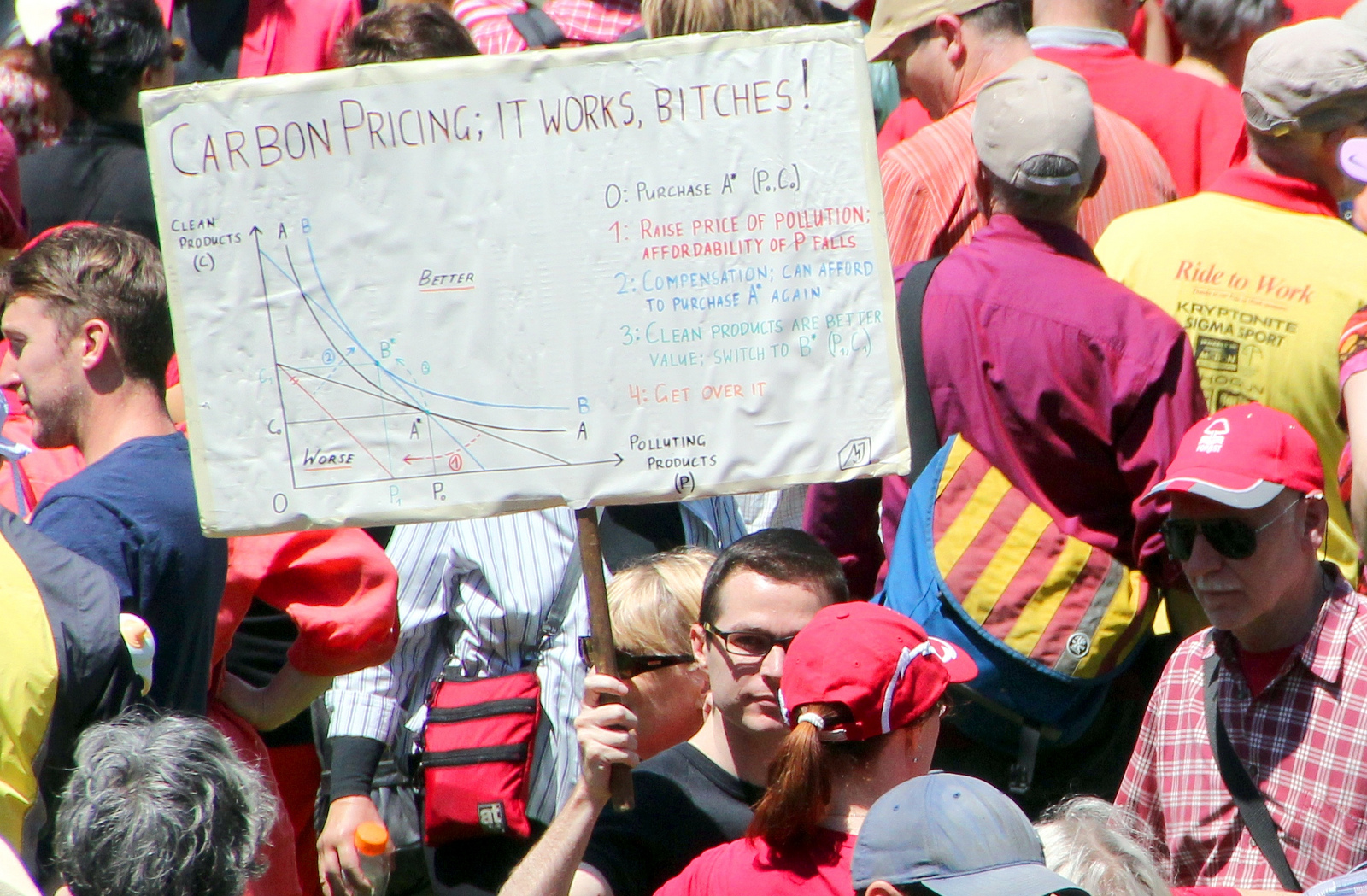
(Click to enlarge.)
Some questions for the economics students:
  • Which vertical line segment illustrates the carbon tax revenue?
  • Which vertical line segment illustrates the compensation paid by the government?
  • Where does the difference come from?
  • What difference would it make if you changed the axis labels from "Polluting Products" and "Non-Polluting Products" to "Watermelon" and "All Things That Are Not Watermelon"?
Answers below.
Answer key: On the vertical line segment descending from B*, the distance from the black line to the red line represents tax revenue (measured in units of "clean products"). The longer vertical line segment descending from B* all the way to the red line represents compensation paid by the government. The difference comes from — hrm. We don't seem to have that information.
So what this sign proves is that if you pay $100 in carbon taxes and get back a $150 gift from the government, you might be better off. As a bonus, it also proves that if you pay $100 in watermelon taxes and get back a $150 gift from the government, you might be better off.
The moral of the placard, then, is not that carbon taxes can be good. It's that all taxes can be good, provided we all get back more than we pay in. All it takes to make that happen is a magic genie (not pictured).

The hatchetmen win: Harry Reid’s muscle move | New York Post


The extremely peculiar rules governing the United States Senate just got a little less peculiar. After a historic vote yesterday, it will now take 51 votes — a simple majority — for most presidential nominations to be approved by the 100-member Senate.
One senator responded with outrage to the idea. The American people, he roared, "don't expect . . . for one party — be it Republican or Democrat — to change the rules in the middle of the game."
His name is Barack Obama.
Sen. Obama spoke those words in 2005 about a Republican proposal to do something very much like what happened yesterday — a proposal thwarted by a bipartisan deal struck by a so-called "gang of 14" that left the old order in place.
http://nypost.com/2013/11/22/the-hatchetmen-win-harry-reids-muscle-move/

Politicians - saying and doing what it takes to keep or get power, whatever it takes.

Excellent Summary


There's more in the article - about as much as can be packed into a page.

http://www.realclearpolitics.com/articles/2013/11/22/for_obamacare_architects_problems_are_features_not_bugs_120751.html
Insurance policies have to include coverage for services that many consumers will not need, including maternity coverage and mental health treatments.  Even Obamacare enthusiasts, such as Harold Pollack of the University of Chicago, suggest that the administration should "revisit just how minimal the most minimal insurance policies should be." But that would work against the Obamacare goal of moving everyone toward paying less out of pocket for health care.
Even more egregious is Obamacare's requirement that policies for one age group cost no more than three times the cost for another. In practice, this means that young consumers, who incur few heath care costs, are asked to subsidize people in old age groups, who incur many more.
This is the opposite of the progressive economic redistribution, which American liberals usually favor.
People in their 20s tend to have negative net worths. They owe more -- in consumer debt, on college loans -- than they have in bank accounts, home equity and financial assets.
In contrast, people in the 55-64 age group, the oldest covered by Obamacare, tend to have relatively high net worths. Federal Reserve wealth statistics consistently show that Americans reach their peak net worth in these years. After age 65, they start spending that net worth down.


Oliver Stone: JFK conspiracy deniers are in denial

I don't care how many shots were fired, or who killed JFK.  It was fifty years ago.  The kind of things JFK supposedly did (I didn't see him do those things, I wasn't born yet, but there's not too many folks denying what he did either), some girl's dad would have killed him for in a different time and place and probably would have been applauded for it.

It doesn't defy logic that the head moved back.  I read an analysis 20+ years ago that explains what happened and replicated the physics with a water bucket.  I've also read of 12 year olds who replicated the shot Oswald made, and those 12 years olds didn't have Marine training.  Being in denial isn't always bad, although it is in vogue right now to say "Anyone who does not believe what I believe is in denial and therefore very, very naughty."

I assume Stone is a progressive but don't know or care - the irony would be that if he is, he makes the libertarian case quite well; you shouldnt trust government and you should want it to be as limited and powerless as can be.  It would take a strange cognitive dissonance to want more government, and government control of health care, when you know govt is prone to corruption.